
Dipole moment calculation#
The get_dipole_moment feature was recently added to the ASE-Espresso interface. Here is we detail how to use it.
Example files#
A set of example files are provided in the tutorial folder of the MatSciToolkit repository. Specifically, the dipole moment calculation is demonstrated in the example_dipole_1 directory.
Example files workflow#
The workflow in the example is as follows:
(01 prefix) Relax the structure (no dipole moment yet parameters yet)
(02 prefix) Run the dipole moment calculation on the relaxed structure
Important parts in the dipole moment input file#
In the 02_get_dipolemoment.py file, the most most important part is the input_data where we specifically set the tefield, dipfield, edir, eamp, eopreg, and emaxpos parameters. These are the parameters that are used to calculate the dipole moment.
input_data = {
    "control": {
        "tprnfor": True,
        "tefield": True, # Specific for dipole moment parameters
        "dipfield": True, # Specific for dipole moment parameters
    },
    "system": {
        "ecutwfc": 60,
        "ecutrho": 480,
        "occupations": "smearing",
        "smearing": "gaussian",
        "degauss": 0.01,
        "edir": 3, # Specific for dipole moment parameters
        "eamp": 0.00, # Specific for dipole moment parameters
        "eopreg": 0.0001, # Specific for dipole moment parameters
        "emaxpos": 0.0001 # Specific for dipole moment parameters
    },
    "electrons": {
        "conv_thr": 1.0e-06,
    },
}
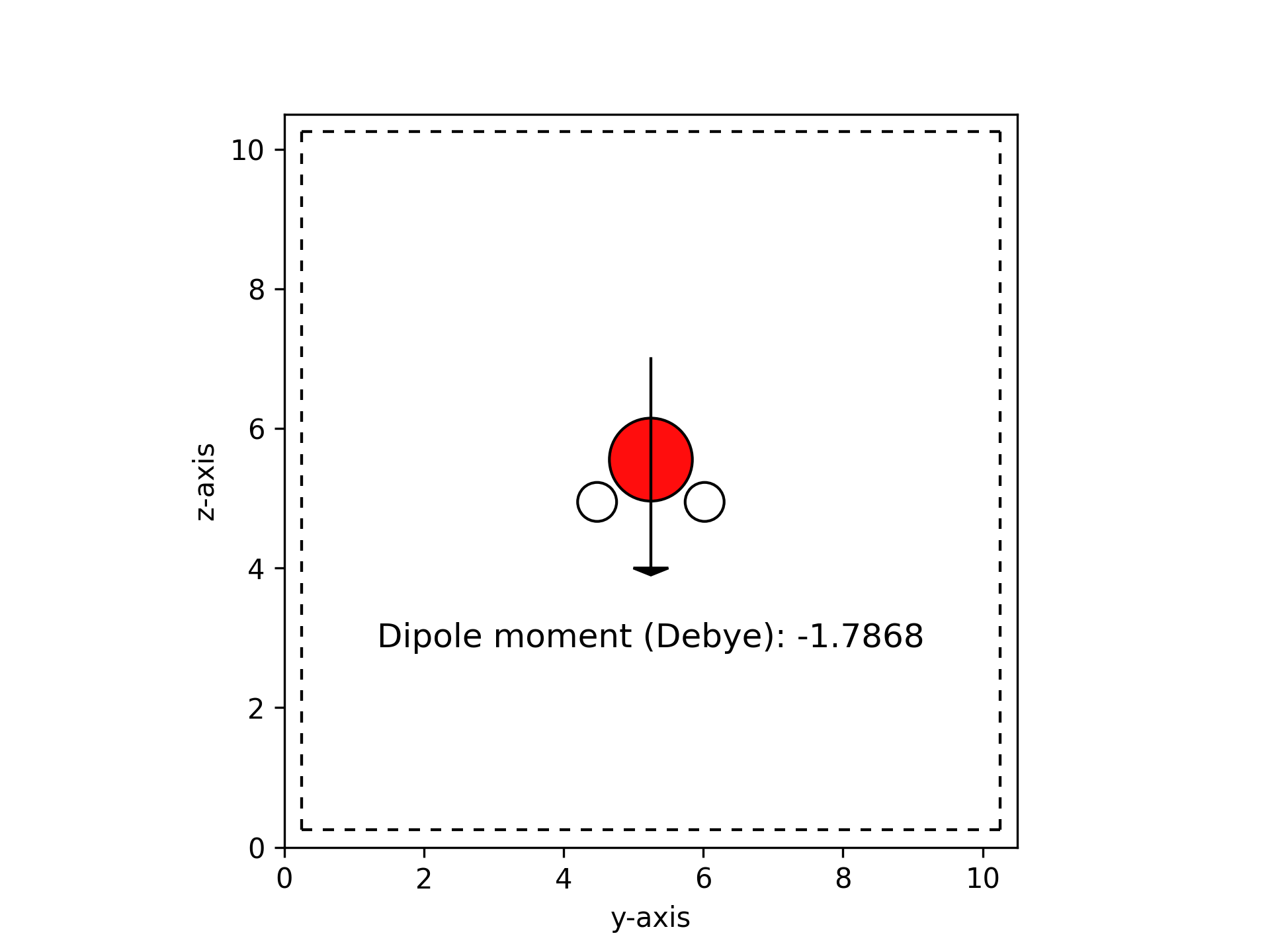
In the example, we have a water molecule where we orient the dipole along z axis. The edir parameter is then set to 3, which corresponds to the z-axis. The eamp parameter is set to 0.00, since technically, we are not trying to induce any electric field. Lastly, eopreg and emaxpos are set to 0.0001, which is the region (in crystal coordinates) farthest from the atomic coordinates.
Example results#
The resulting dipole moment is about -1.78 Debye, quite close to the expected value of -1.85 Debye. Here is a quick visualization.
Note
Why is the sign different with VASP?
I honestly have no idea. However, this maybe due to convention. In VASP the dipole moment calculated is positive but in QE its negative. QE’s dipole moment direction is more aligned with the physicists’ convention (negative to the positive charge).